

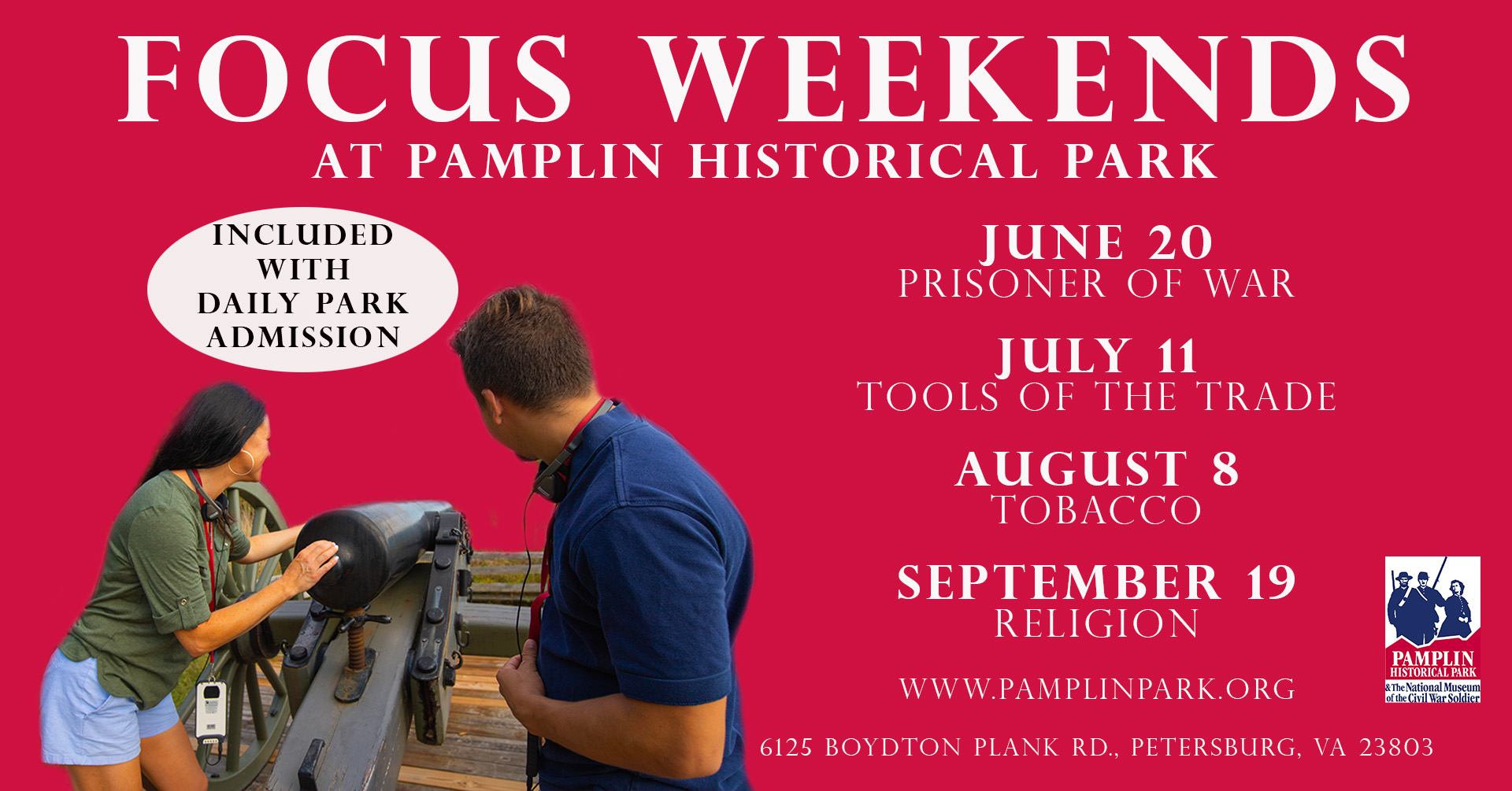
Tools of the Trade
Discover how Americans lived and worked in the 1800s through special presentations on everyday objects, woodworking, and traditional crafts.
Program Schedule
- 11 a.m. – Ordinary Objects Among the Antebellum Population
Explore pottery, glass, utensils, and other artifacts from the park’s collection, and learn how daily life differed among social classes. - 12 p.m. – World of Wood
Learn about the importance of woodworking in the 19th century and see a variety of tools used to create essential household items. - 2 p.m. – Basketmaking Demonstration
Watch the process of turning wood into baskets and see examples in various stages of completion.
Programs are included with paid park admission from 9 a.m.–5 p.m. at Pamplin Historical Park, a National Historic Landmark in Dinwiddie County, Virginia, featuring museums, historic homes, and the Breakthrough Battlefield of April 2, 1865.
Organizer
What began in 1991 as an effort to preserve a threatened Civil War battlefield near Petersburg, Virginia, has evolved into one of America’s finest history and heritage travel destinations.
Pamplin Histor ical Park & The National Museum of the Civil War Soldier is a 424-acre historical campus that features world-class museums, antebellum homes, a National Historic Landmark Civil War battlefield, a slave life exhibit, educational programs, and special events. It has been called “the new crown jewel of Civil War sites in America” by Pulitzer Prize-winning historian James M. McPherson of Princeton University.
Pamplin Historical Park’s 424 acres encompasses The National Museum of the Civil War Solider, Tudor Hall Plantation, the Field Quarter, the Field Fortifications Exhibit, the Military Encampment, the Battlefield Center, the Breakthrough Trail (and other trails) as well as the Banks House and the Museum’s Gift Shop.